project backdrop
How do punctuations structure meanings and reveal ourselves?
Growing up in a hyper-digital culture, I often felt a gap between myself and the words I used—language never seemed to fully capture who I was. Inspired by Derrida’s différance and our current post-truth reality, this project explores punctuations as the truest marker of the self, instead of the more porous written & spoken language.

fig.1
Our current political climate can be described as post-truth, where there exists a heightened "public anxiety about what claims can be publicly accepted facts" due to the growth of social and digital media.
interdisciplinary research
Upon research, I've adapted Derrida's theoretical différance…
This project looks at punctuation as both a mark of difference (Rabaté 2019) and a design element in UXD (Parkes 1992). It explores how pauses can shape meaning and identity in a post-truth world where written and spoken languages feel unstable. Through this project, I aim to explore my own sense of self, asking how we can show who we are when words can mean almost anything (Waisbord 2018).

fig.2
Derrida's 'différance' explained!
Let's then introduce the project's core tenets:
Punctuation Subverts Différance
From 'différance', we know that a language's meaning is never fixed—it shifts, because words gain meaning by differing from one another.
Punctuation as Architectural Objects
Then, rather than words, I aim to map punctuation (these more stable entities) onto my body to reveal my language’s true meanings, its breaks.
Punctuation Being a UX System
Punctuation, like a UI, guides rhythm and meaning (Parkes 1992); this project treats it as an affective interface between language and self-meaning.
project methodology
Visualizing the smallest markers of language
To visualize punctuations, I use TouchDesigner—a real-time node-based visualization platform ideal for interactive installations. I focus on four punctuation marks—commas (,), periods (.), question marks (?), and ellipses (...)—chosen for their prominence in language, introspective quality, and personal relevance in my writing.
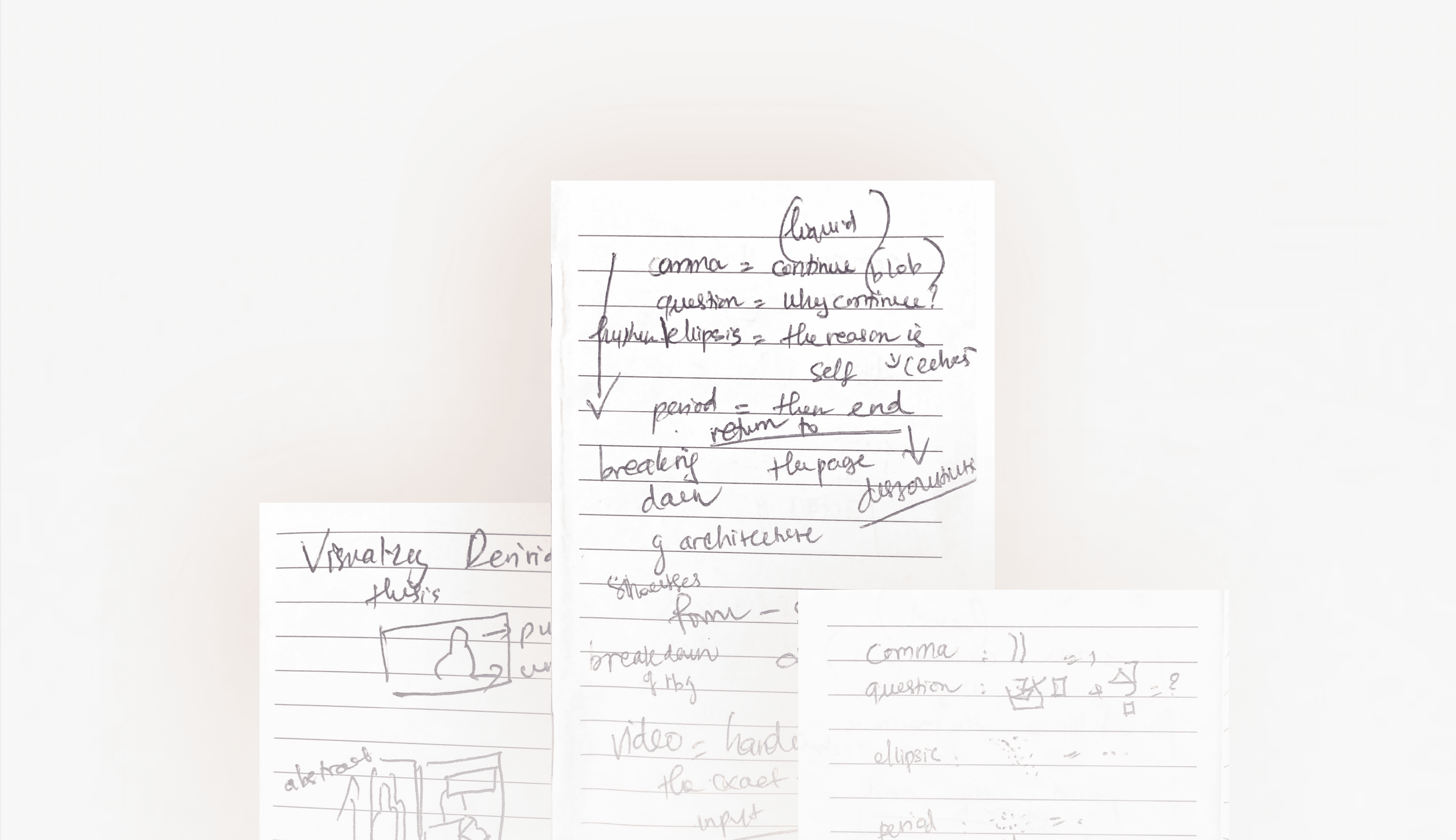

fig.3
My low-fidelity design of the installation & its storyboard
Why mapping punctuation marks onto my live body?
Due to the goal of 'seeing myself' transparently in the post-truth world, my live body silhouette becomes a reactive canvas, transforming in real time based on the punctuation counts in my own personal writing (as writing is something I'm deeply passionate about).

fig.4
Video installation's setup
Each punctuation mark counted triggers a distinct visual effect that reflects both its physical form and textual function…
Each punctuation's effect is called a 'view', which reflects how my body changes after a specific number of marks is processed.

01
Comma View
The body is made liquified whenever moved, symbolizing a comma’s continuity effects.

02
Question View
The body is blob-tracked and traced, symbolizing a question’s self-interrogation effects.

03
Ellipsis View
The body is made greyscale, and turned loopy, symbolizing an ellipsis’s echoing effects.

04
Period View
The body is further abstracted into RBG particles, symbolizing a period's ending.
installation logics
To animate the abstract, I also created two flowcharts to map out the visualization's logics
The visualization follows a layered structure where each punctuation mark’s effects are compounded and are mapped to a classic narrative arc: rising action (comma), climax (question), falling action (ellipsis), and resolution (period).
Systematically and Narratively Visualized

fig.5
Each punctuation's effects are compounded

fig.6
System architecture, from beginning to end
project technicalities
My first attempt at TouchDesigner was quite hectic…
In order to technically create the visualization, I kept writing and rewriting a Python program that reads inputted text & counts for more than four punctuations, then records these counts to a table. The TD nodes were also difficult to get used to as a first-timer…

fig.7
How TouchDesigner reads input texts and outputs punctuation counts
Yet again, in a corny way, every disaster gives way to a blue-sky vision
Nonetheless, once I simplified the project (ridding of LeapMotion air gestures), & nailing down its essential skeleton (punctuations can be a personal language), I started clearing away all technical hurdles. I thus created four main modules, where each visualizes a specific punctuation mark using nodes tailored to its effect.


fig.8
Comma, Question, Ellipsis and Period Modules
FINAL visualization
All began with this one question: Can I express myself more honestly through language’s structure than its content?
This project, in the end, revealed itself as an embodied system that visualizes punctuation as an epistemological medium: self-knowing through data input and emotional mapping. (Refer to the legend below to help interpret the visualization before viewing it in full.)

fig.9
The visualization's legend
video installation
Instead of privileging words, the project celebrates silences & ruptures—an alternative interface for meaning-making
In doing so, the installation suggests a new UX paradigm: one that listens to hesitation, delay, and opacity as the true form of human truth, and as processes of meaning-carving.
VIEW Full Visualization
fig.10
Final visualization output
reflection
Some of my behind-the-scene stories…
Okay, I think it is time to reflect on my journey (its trials & tribulations...) towards completing this project so far!
Purposeless Project?
No! I really do think this project pushes back against mainstream UX by embracing ambiguity, suggesting on the interdisciplinary, theoretical and human nature of design.
Perfect Imperfections
Real-time text-scanning and Leap Motion air-writing were explored but ultimately dropped due to time and skill constraints. So—getting the main working skeleton down is key!
Laser-Focused Trials
My first time using TD, I taught myself through trial, error, and community support. The result—a modular, concept-driven system—fuses poetics, design, and critical theory.
Let's Dream…
Future versions may include more punctuation and features like voice activation or affective computing to deepen the link between poetics and embodied computation.

fig.11
The many failed attempts that I've got through when completing this project!