Project intro
As my grandmother's memories ail, I search for ways to keep them alive.
As I grow, I often reflect on the nature of memory and how it shapes our relationships. My grandmother’s diagnosis with dementia, in particular, has made me think deeply about how I personally hold onto and honor the moments I share with my loved ones.

fig.1
Pictures of my paternal and maternal grandparents
Statistically, 55 Million Worldwide were Living with Dementia in 2020…
According to Alzheimer's Disease International, this number is expected to skyrocket to 139 million by 2050.
problem statement
Then, how might we retain and archive our own memories, when your loved one has dementia?
The Stark Absence of Dementia-Assisted Technologies
My initial reading and application searching revealed that there exist only a few digital applications that cater to dementia-affected individuals and their caregiving loved ones.
the solution
This is a sneak peek of Here, the app I've built to solve this problem.
Memory Archive with AR Integration
Caregivers & dementia-affected individuals can create a private or sharable archive of artifacts. Using AR, they can scan items and re-immerse in place-based memories.
Community Sharing with Privacy Protections
Caregivers can share selected memories in topic-based communities. This aims to foster a sense of belonging, while protecting privacy.
Health & Well-Being Monitoring
Here syncs with other tools to track the dementia-affected individual's health. Caregivers can also customize meditation exercises tied to their own memory artifacts.
product thinking
The user and market-minded road towards the solution.
user Research
A deeper grasp of the problem is needed
First, I tried to contact the Alzheimer Society of Canada to gain interviews with doctors and/or caregivers of dementia-affected individuals to gather user needs. I scheduled 3 interviews with dementia specialists and one patient, then grounded those insights in a review of current secondary literature.

fig.2
My email attempt with the Alzheimer Society of Canada
secondary research
“The global rise in dementia is driving a technological revolution in care for patients and caretakers.”
The secondary research helped illuminate the problem core. All 6 research articles emphasize the need for an educational, collaborative environment, as well as place-based recollection of past experiences for dementia patients (Stoia 2020; Miron 2023; Masoud 2021; Brodaty 2005; Bhargava 2022; Chaudhury 2002).
Caregiver Stress & Social Support
Caregivers are prone to burden and stress-relief meditation only helps short-term.
Community & Social Inclusion
Virtual memory cafés and group activities give people with dementia a sense of belonging.
Emerging Tech & Data Privacy
Wearables, smart sensors, and VR offer promising support but need to consider data privacy.
Place-based Reminiscence
Reconnecting with familiar places and distant past memories provide therapeutic values.
Product audit
An audit of the dementia-care, tech landscape
I found that very few applications are designed for caregivers or loved ones of people with dementia. Those that do exist often oversimplify the condition, focusing mainly on repetitive, impersonal memory games or basic meditative exercises.


fig.3
Some prevalent digital products that aim to help dementia-affected individuals
A Critical Red Flag: Many Dementia-Affected Elders Struggle with Learning New Technologies!
They also need more meaningful ways to connect with their loved ones—often their primary caregivers—to strengthen these relationships critical to their mental health. Thus, with existing products, most are often left with closed-off exercises that are difficult to sustain as memory fades.
PRODUCT FRAMING
All roads lead back to our user groups.
I knew there has to be a brand-new approach to dementia care. I thus tried to understand the user pain-points better by creating two personas wholly based on market and research insights: Desdemona and Daemon. Each persona represents a user group—caregiving loved ones and dementia-affected individuals.

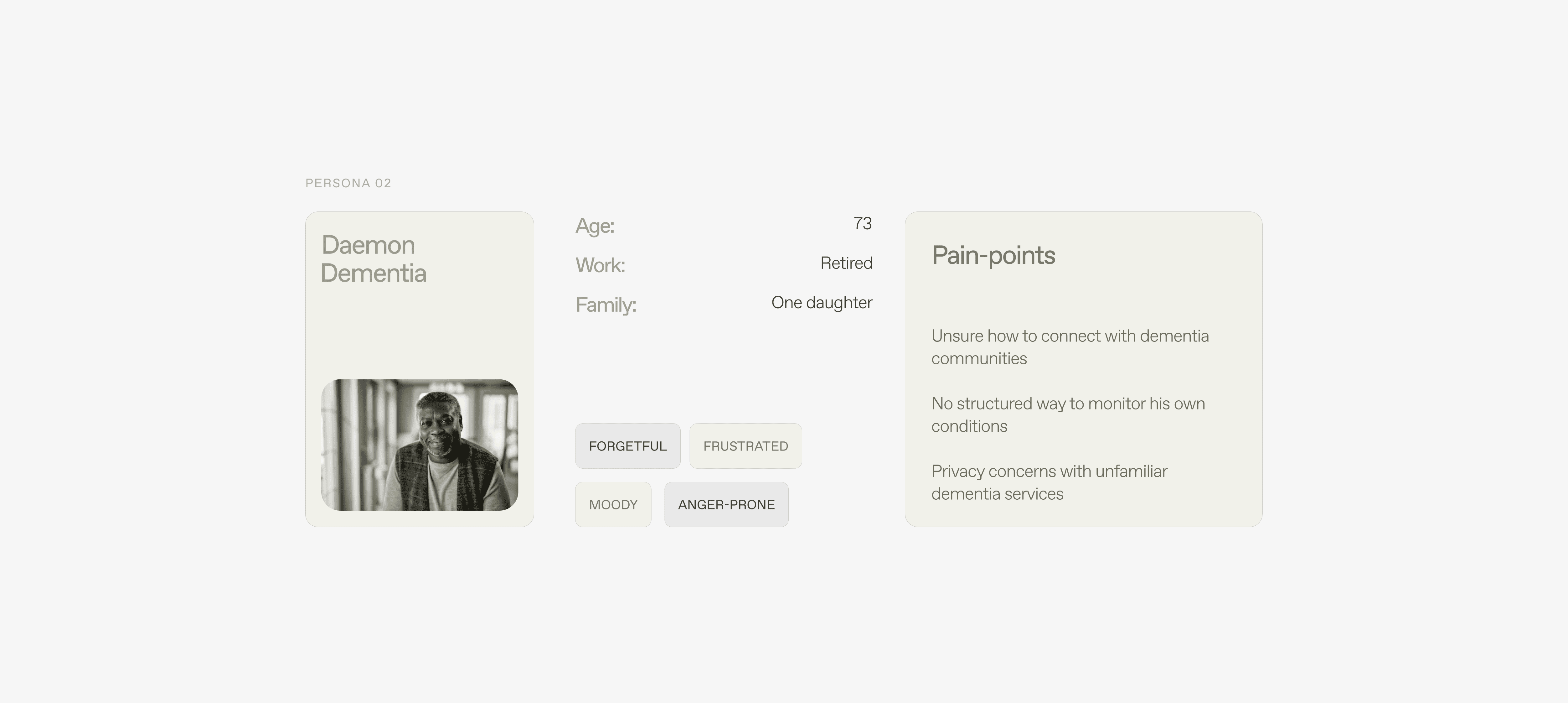
fig.4
The two personas for two user groups: dementia-affected patients and their caregivers
From user pain points reflecting the relationship dynamics of dementia, I derived three design principles to address them.
Memory Archive
Desdemona needs to emotionally connect with place-based memories of her father.
Community Bonding
Daemon needs to privately connect with dementia-affected communities to feel belonged.
Health Monitoring
Both needs to auto-monitor Daemon’s health, to keep check of his at-home conditions.
Prioritization matrix
From drafted ideas to a MVP full of 'home-run' solutions?
With the design principles in place, all it took was ideas. I quickly generated 12, each color-coded to one of the three principles above, then ranked them using a Prioritization Matrix to get my MVP.
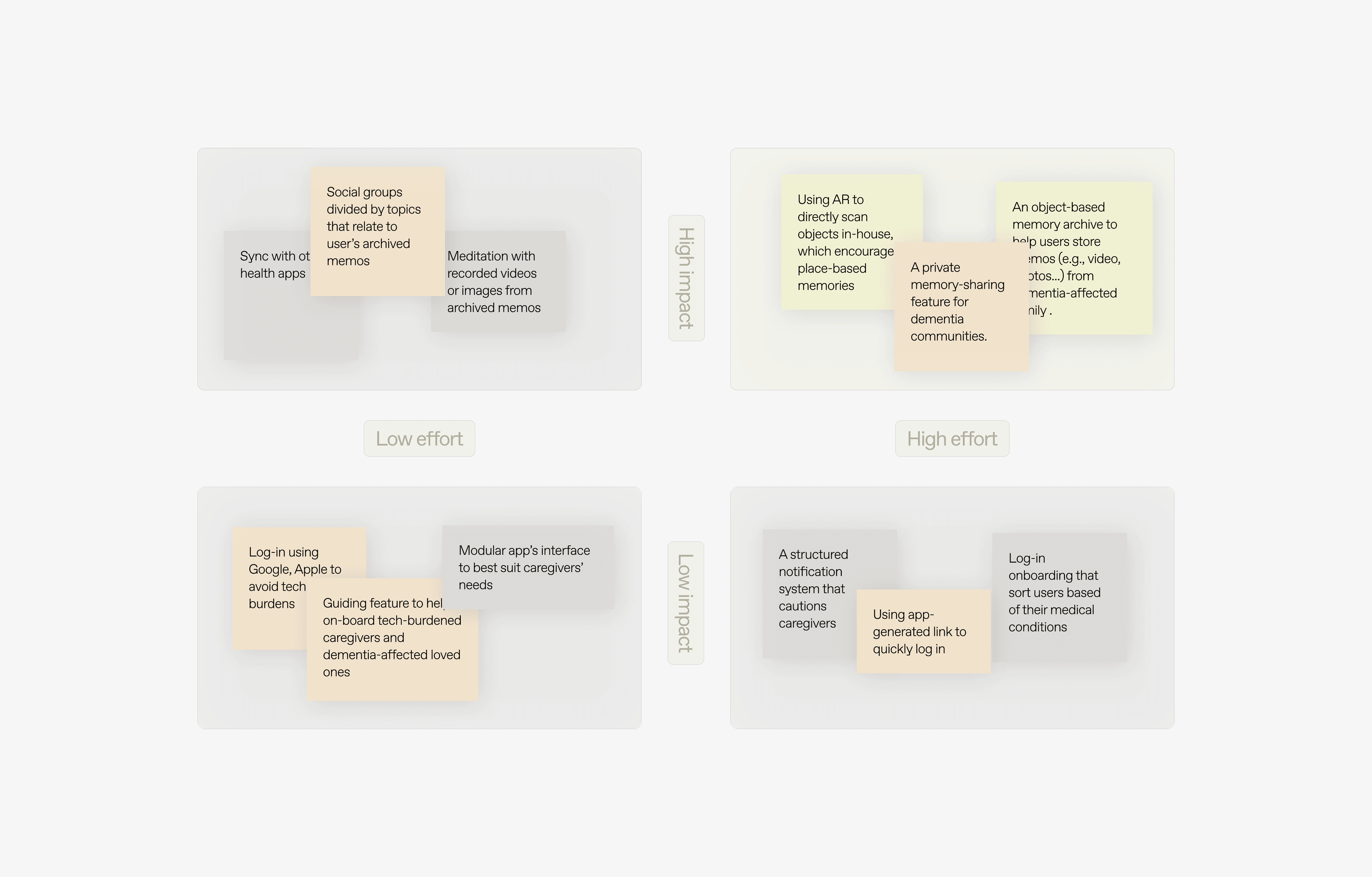
fig.5
The prioritization matrix I employed to get to the MVP
information architecture
Structuring dementia care for Daemon with intent.
Choosing ideas within 'Low effort & High impact' and 'High effort & High impact' as my blue-sky solutions to the problem, I structured each into three main pages—Well-being, Community, and Memory.

fig.6
How I planned out the information architecture of the app
design process
From Insight to Imagination: First Sketches of the Product
To actualize the IA and planned user flows, I began creating the low and medium-fidelity of the designs on paper and Figma. Below are these initial sketches, divided up into the Home page, and then the three main product features.

fig.5
My low to medium-fidelity prototype of the application
usability testing
Reminders: I ≠ the users & the first design is usually not the best design…
To move the early-stage prototype forward, I began my lean usability testing with 2 UX Designers. As I iterated, I realized I had fallen into a trap: I was designing for myself, not the users.
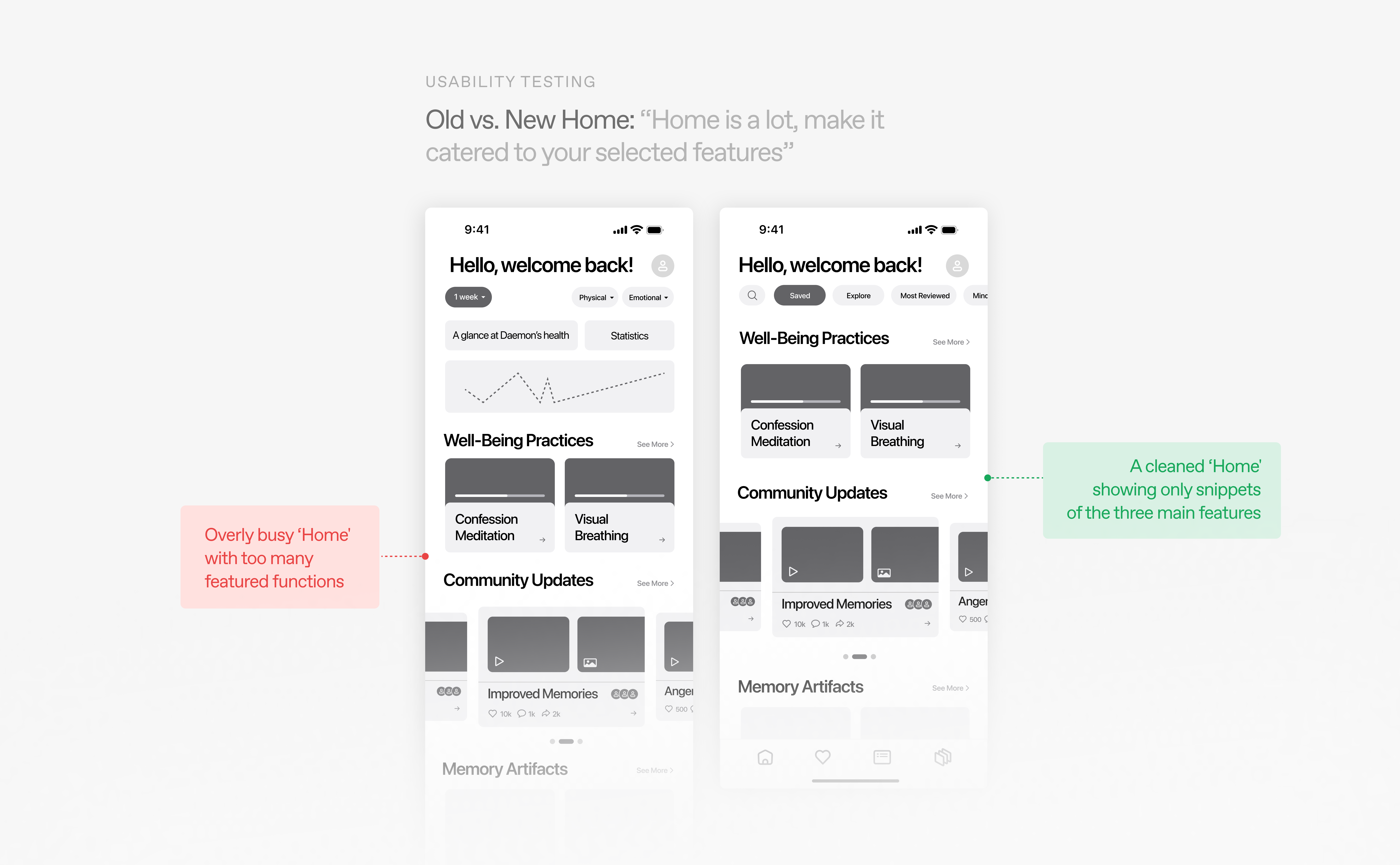

fig.6
Usability testing of the 'Home' and 'Memory' pages
‘Well-Being’ page, in particular, went through many iterations due to its complex flow of health monitoring and meditation exercises, which I worked hard to reconcile.


fig.7
Usability testing of the 'Well-Being' page
Lesson Learned: Iterative Testing Keeps Users Engaged in the Design Thinking Loop.
Instead of simply rolling out designs—even when following a structured design thinking process—I can easily overlook users’ real needs. Iteration helps keep me grounded in the user’s perspective.
high-fidelity protoype
Rapid-prototyping more than 65+ frames for Desdemona and Daemon…
After spending hours turning the validated medium-fidelity design into a high-fidelity prototype, I could finally see the application taking shape, moving from rough sketches into something tangible.

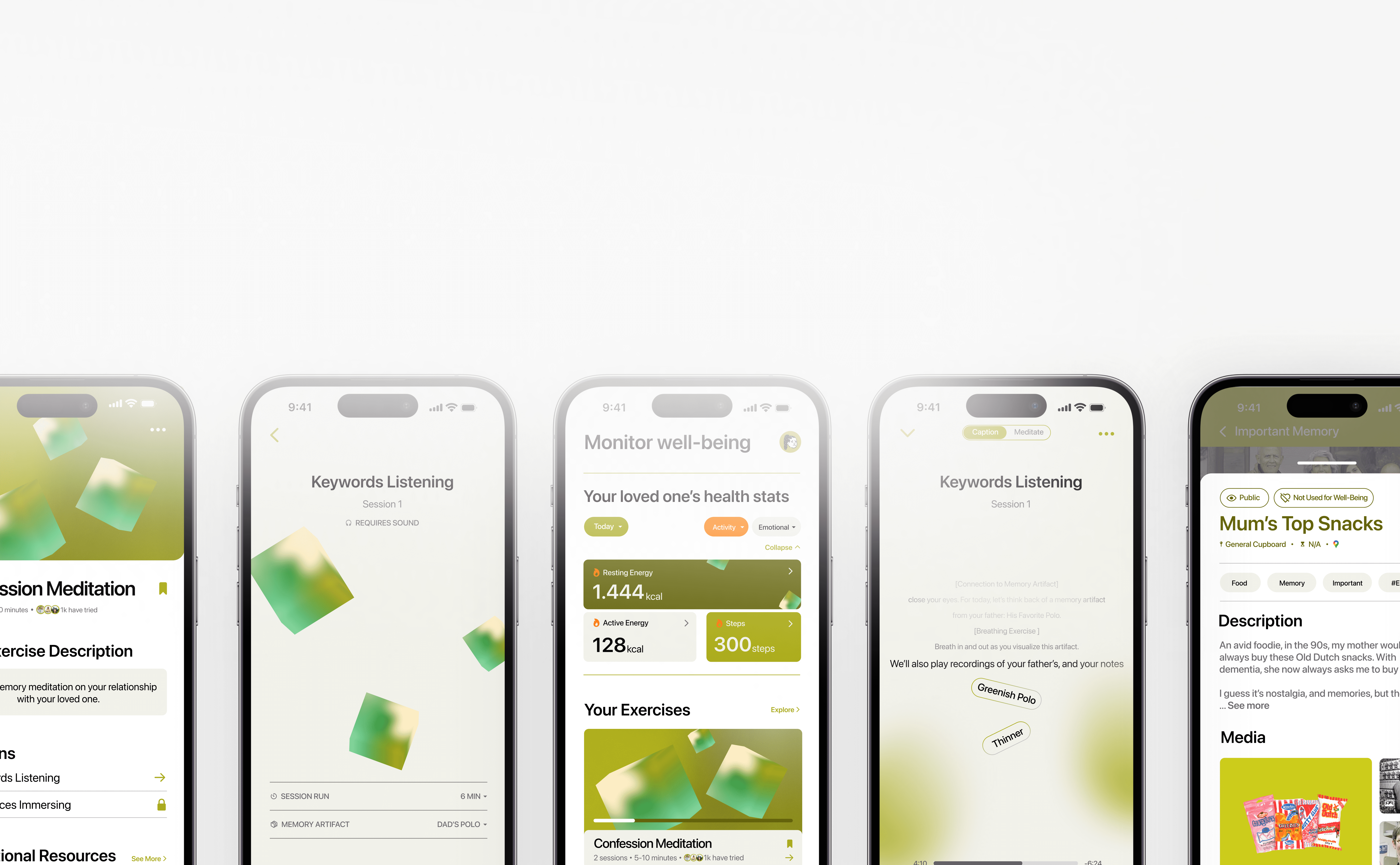
fig.8
Some representative frames that I've prototyped for the application
Design decisions
Previous research insights cobbled the path for every design decision I've ever made.
Each design decision I made directly adapts the research insights I first uncovered, from memory-based archive to health monitoring with meditation and dementia communities.


Recommending Meditative Exercises through Metrics
With discoverable communities, Daemon and Desdemona can easily find meditative exercises—each one tied to a memory artifact and enriched with personal videos or voice recordings, making the practice more personal and meaningful.

style guide
When aesthetics tell one cohesive story
To reach the final prototype, I chose green as the main color. It's not just a decorative color, but one that conveys healing and naturalness. Font sizes too follow strict iOS standards, and the color palette is scaled for consistency. The style guide includes 15+ reusable components, along with custom illustrations for card sections without images.
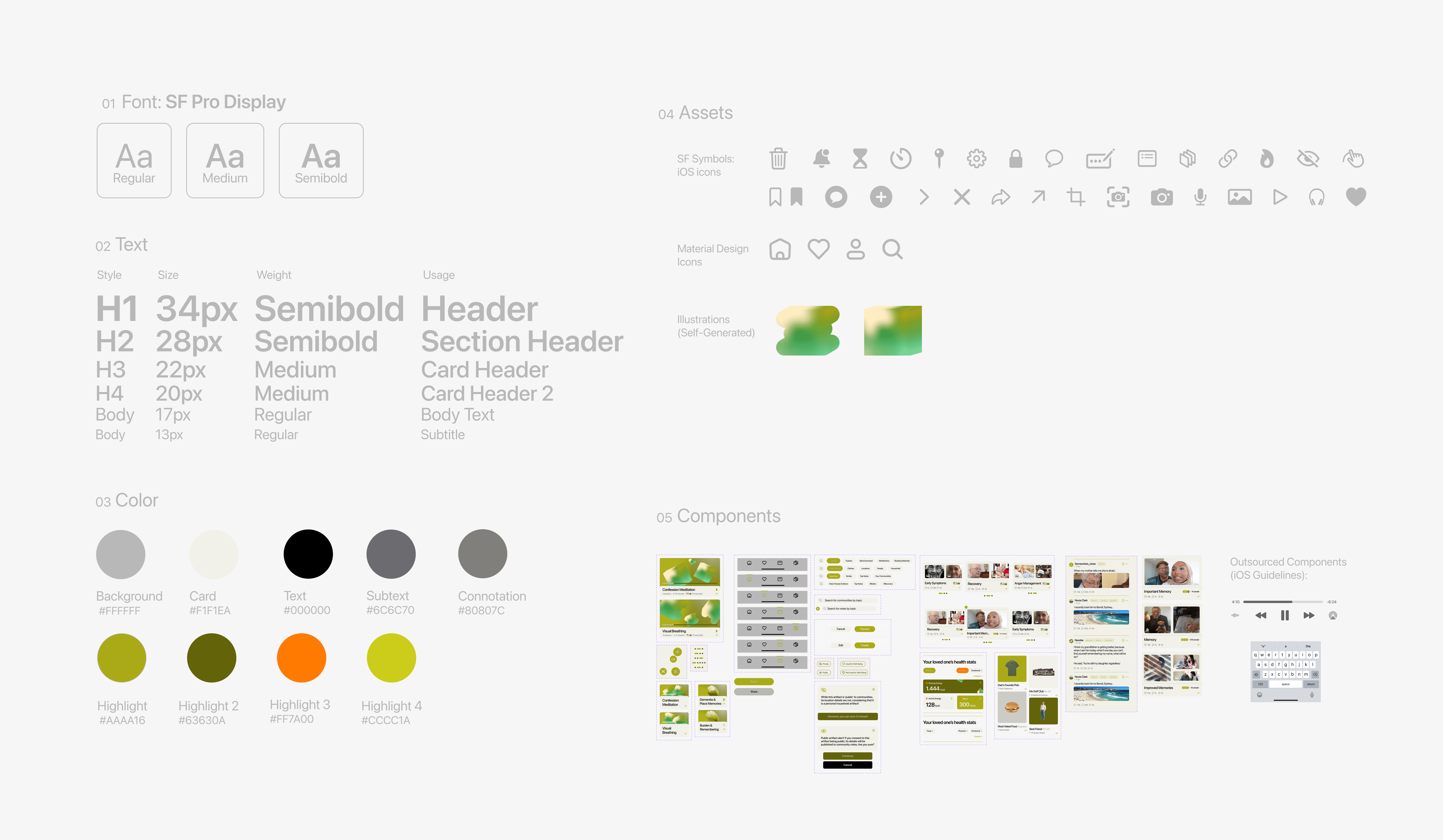
fig.9
Style guide library for the application
design evaluation
Here means, after all, we'll still have the present moment.
This is the title I've decided to settle on after finishing up this project, as it encapsulates a caregiver like Desdemona's primary need: to connect with her dementia-affected father, Daemon, whose memory is ailing.
No longer forget keepsakes dear to one's heart.
Whenever Desdemona wants to archive her father’s fading memories, she can add audio, voice notes, or videos through a privacy-minded and detail (yet-easy-to-fill) form.
Safeguard personal memories with alert messages.
When looking at Desdemona's mementos of her father on diverse dementia community forums and notes, other users are alerted by the private nature of such objects.
Meditation hits closer to home with memories by one's side.
Desdemona can integrate details about Daemon, drawn from her logged mementos, into custom meditation exercises that help him recall memories through place-based recollection and familiarity with his past.
An all-inclusive Home & an assistive Settings.
The Home page shows updated snippets of key features, letting Desdemona and Daemon view new community artifacts. The Settings page allows layout customization and privacy controls.
Personal metrics
My metrics for Here are emotions-first and home-grown!
I, in fact, ran a second-round usability testing with three UXDs after the high-fidelity stage, and the feedback was overwhelmingly positive.
After all…
This project means a lot to me. Its concept is exploratory and a bit “out-there,” and being my first digital design ever, I’m proud of the outcome: a human-first system aimed at addressing unmet needs.
reflection
Is it now time to say goodbye?
More than perfection, the project proved that under extreme time constraints, I could take a deeply human challenge and shape it into a structured, iterative journey. I'd love to share a few reflections before we go.
Why Mobile?
Given the older demographic of dementia patients, the mobile format (while portable and easy to hold) isn't always be accessible. In the future, I plan to iterate a larger-screen version.
A Lack of Constraints
Here is conceptual at its core, with features like connecting dementia communities posing significant risks. For instance, how do we verify dementia or ensure privacy?
Sounds On!
One huge plus of Here is its inclusion of multimedia interactions, from videos to voice notes. This aspect truly makes the project whole and personalized to how caregivers want to bond with dementia patients.
Uncharted Territories
Many concepts and features in Here didn’t make it in due to time and scope limits. Settings—meant for privacy safeguards—is another area I plan to expand in future iterations.